

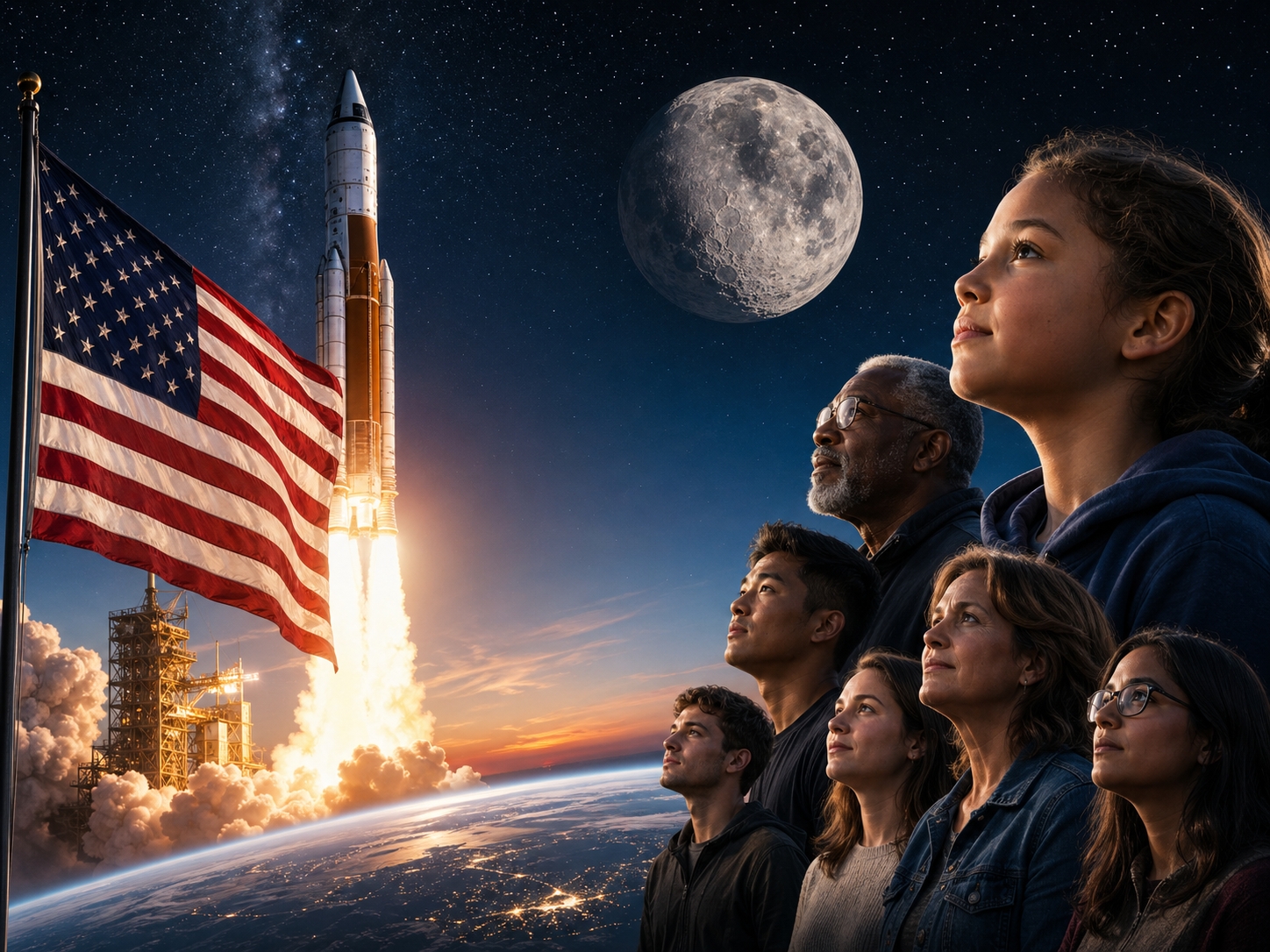
When NASA launched four astronauts aboard the Orion spacecraft on April 1, 2026, it marked the United States' first crewed journey to the vicinity of the Moon since the Apollo era. Artemis II was designed as a test flight—a roughly ten-day loop around the Moon and back, intended to validate the spacecraft, rocket, and deep-space systems that will eventually carry astronauts to the lunar surface. But beyond the engineering milestone, the mission posed a quieter question: does the American public still believe in this kind of endeavor?
Survey data collected around the mission suggest the answer is yes—but with important caveats about who is most enthusiastic, who is most ambivalent, and what is actually driving support.
Broad support, with a telling asterisk
At the headline level, public sentiment toward Artemis II is solidly positive. Nearly three-quarters of respondents say the mission makes them excited about the future of space exploration, and roughly seven in ten say it makes them feel proud of what the United States can accomplish in space. Support softens somewhat on the harder policy questions—about two-thirds call it a worthwhile use of public resources, and just under two-thirds say missions like Artemis II should be a national priority—but majorities hold across the board.
What makes the data genuinely interesting is a tension embedded within that support. A 62.8% majority simultaneously agrees that missions like Artemis II are "more symbolic than practically useful." Americans, in other words, are not supporting the mission because they reject the symbolism critique. They are comfortable holding both ideas at once: the mission can be inspiring, pride-inducing, and worth the money and largely symbolic. For anyone thinking about how to communicate the value of deep-space exploration to a general audience, this is a meaningful finding. The emotional and patriotic case for Artemis II appears to be doing the heavy lifting—and it doesn't require winning a utilitarian argument about concrete returns on investment.
The partisan surprise: it's not Democrats vs. Republicans
Given the polarized state of American politics, one might expect attitudes toward a major federal program to split cleanly along party lines. They don't—at least not here.
Democrats and Republicans are essentially indistinguishable in their support for Artemis II. On excitement about the future of space exploration, Democrats net-agree at 78.2% and Republicans at 77.4%. On national pride, the numbers are 75.4% and 74.1%. Even on whether Artemis II should be a national priority, the gap is a single percentage point (66.5% vs. 67.6%). Space, it turns out, remains one of the few domains where the two parties are not pulling in opposite directions.
The real partisan divide is between people who identify with either major party and those who identify with neither. Respondents with no party affiliation are 15 to 20 points less positive on every measure—60.2% on excitement, 55.2% on pride, and just 47.1% on whether the mission should be a priority. That last figure means non-partisans are essentially split on the question of whether Artemis II deserves to be prioritized at all. The largest single gap in the entire partisan analysis is on worthwhile use of public resources: 73.4% among Republicans versus 51.5% among non-partisans, a nearly 22-point spread.
This pattern suggests that the relevant fault line is not ideological orientation but political engagement itself. People who have chosen to affiliate with a party—regardless of which one—are more likely to view a major national program favorably. Those who have opted out of partisan identity are also, it seems, more skeptical of large-scale government undertakings.
Democrats and Republicans cluster together on every item, while non-partisans consistently trail by 15–20 points—making political disengagement, not partisan identity, the more meaningful dividing line.
Income matters, but education matters more
If partisanship is a weaker predictor than expected, income and education are stronger ones—and together they paint a portrait of where enthusiasm for Artemis II is concentrated and where it fades.
The income gradient is clear and consistent: support rises at every income level on every item. The steepest climb is on whether the mission is a worthwhile use of public resources, which goes from 59.5% among respondents earning under $50,000 per year to 78.8% among those earning $150,000 or more—a gap of nearly 20 points. Even the lowest-income group remains majority-positive on most items, so this is less a story of opposition than of varying degrees of enthusiasm.
Education tells a related but distinct story. Support rises with educational attainment, but the relationship is not a smooth gradient—it is more of a step function, with the most dramatic jump occurring at the graduate-degree threshold. From less than high school through a bachelor's degree, net-agreement levels are relatively clustered, ranging roughly from the low 50s to the mid-70s depending on the item. Then, at the master's and doctoral levels, support surges: 88.8% and 89.4% on excitement, 85.6% and 87.5% on worthwhile use of resources, and a striking 75.0% and 89.6% on whether Artemis II should be a national priority.
The single largest gap in the education analysis is on that last item: PhD holders net-agree at 89.6% that Artemis II should be a U.S. priority, compared to 51.6% among those with technical or trade education—a 38-point spread. Notably, respondents with vocational or trade backgrounds are the least supportive subgroup across every item, falling even below those with less than a high school diploma. This may reflect a practical, applied orientation that makes the "symbolic vs. useful" critique feel more salient: if a mission cannot be connected to tangible, near-term outcomes, it may be harder to justify from a vocational worldview.
All three lines remain relatively flat from less-than-high-school through bachelor's degree, then jump sharply at the master's and doctoral levels—a "graduate bump" that is especially pronounced on the question of national priority.
The education effect is not simply a proxy for income. While the two variables are correlated, the income gradient is relatively smooth across four bands, whereas the education gradient is flat-then-sharp. This suggests that something specific to graduate-level education—perhaps greater familiarity with scientific research, longer time horizons for evaluating national investment, or stronger identification with knowledge-economy institutions—is independently shaping attitudes toward Artemis II.
A consistent gender gap, concentrated where it matters most
Men are more supportive than women on every item, with gaps ranging from about 7 to 12 percentage points. Crucially, the widest gaps appear not on the emotional items but on the policy-evaluation ones. On whether Artemis II should be a national priority, men net-agree at 67.7% versus 56.1% for women—an 11.6-point gap. On worthwhile use of public resources, the spread is 11.0 points (72.1% vs. 61.1%). The emotional items—excitement and pride—show somewhat smaller gaps of around 9 to 10 points.
This pattern is worth pausing on. Women are not disengaged from the mission emotionally; they are simply more skeptical about its policy justification. That distinction matters for how the mission is framed in public communication. An appeal centered on inspiration and national pride will resonate more evenly across genders than one centered on fiscal or strategic rationale.
What the data add up to
Taken together, these findings sketch a coherent portrait of where Artemis II support is strongest and where it is softest. The most enthusiastic supporters tend to be higher-income, graduate-educated men who identify with one of the two major parties—a group for whom the mission's scientific ambition, national prestige, and long-term strategic logic all resonate. The most ambivalent respondents tend to be lower-income, non-partisan women with vocational or some-college backgrounds—a group for whom the symbolic-versus-useful tension is harder to resolve in the mission's favor.
None of this means Artemis II faces a public-opinion problem. Majorities across virtually every subgroup support the mission in some form. But the data do suggest that the case for deep-space exploration lands differently depending on who is hearing it—and that the most durable argument may not be the most obvious one. Americans don't need to be convinced that going to the Moon is practically useful. They already feel proud and excited. The harder task is persuading those who are less engaged, less affluent, and more skeptical of large institutional endeavors that the mission is worth the cost—and that is a question of values and priorities, not just facts about orbital mechanics.
Data are drawn from a survey of approximately 1,471 U.S. adults who completed a five-item Artemis II attitude battery. All figures reported are descriptive net-agreement rates (share selecting "strongly agree" or "somewhat agree"). The survey sampled U.S. adults (18+) and was quota balanced by age, gender, education, income, and state.